

Market segmentation is a fundamental marketing strategy used to divide a large, diverse, heterogeneous consumer population into smaller, more manageable groups of people with shared characteristics. Instead of trying to appeal to everyone, aka “marketing to the mean,” businesses can focus their efforts on specific segments of the consumer population that match the brand promise of their products, which leads to more efficient marketing and an exponentially higher return on investment.
Understanding Market Segmentation
“Segmentation” is one of those words that means vastly different things to different people. To some, segmentation is a basic crosstab of age and sex demographic characteristics. To others, it’s a subset of a list of consumers to be targeted for a direct mail campaign based on their propensity to do something, try something, or buy something.
The core purpose of segmentation is to move from a broad, general marketing and messaging approach to a precise, targeted one. That simple cross-tabulation of demographics like age and gender is indeed a basic form of segmentation, but it lacks the depth needed for truly effective marketing. A more sophisticated definition of segmentation involves using scientific and statistical methods to classify consumers into discrete, homogeneous groups based on common interests, attitudes, opinions, or—most importantly—unmet needs.
The ultimate goal of this process is to achieve quantifiable efficiency. By identifying a specific audience with particular needs that a product is designed to fulfill, a company can focus its marketing resources on that group, maximizing its chances of success. It’s unrealistic to create a product that appeals to everyone; even universally popular products like mobile phones had a specific initial target audience (“intenders”) before mass adoption of mobile technology made the concept of intenders anachronistic and obsolete.
By targeting a narrow segment of the consumer audience, manufacturers can spend their marketing dollars more efficiently and get a better return on their research and development investments. This strategic focus has long been the measure of a successful market segmentation study.
The Evolution of Segmentation
Historically, needs-based segments were developed by collecting attitudes and opinions from large, carefully curated consumer samples. Still using the survey instrument, this data was then supplemented with factual characteristics like demographics, geography, and socioeconomic factors. The assumption was that if you understood the needs of a segment, you could identify and target them “in the wild” based on these observable characteristics. In other cases, organizations relied on a priori segments, which are groups that share important defining characteristics with known, existing customers. This allowed marketers to use these characteristics as proxies for the needs-based segments, giving them a reasonable expectation of accuracy.
The “Segment of One” Approach
Recent advancements in data science and modeling are enabling market segmentation models to be far more precise. Instead of targeting groups based on broad demographic proxies, it’s now possible to target consumers as a “segment of one.” This means using sophisticated models to assign a probability of belonging to a specific needs-based segment to hundreds of thousands, or even millions, of individual consumers by name. This level of precision allows for more effective targeting than ever before, since marketing, messaging, and offers can be tailored to specific individuals based on the results of the segmentation scheme.
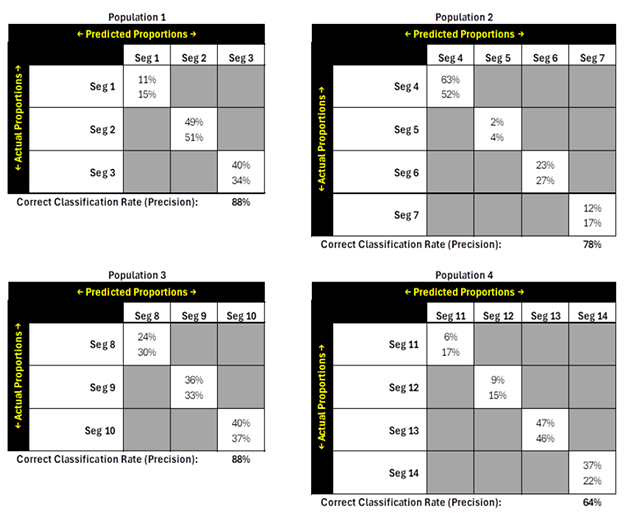
In a recent test case for a health insurance provider, this methodology was used by Data Decisions Group to identify 14 different consumer segments within four distinct populations. The goal was to reliably identify “look-alike” consumers who met the provider’s a priori segment definitions. The process was a resounding success, demonstrating that this highly precise, data-driven approach is not only feasible but also incredibly effective.
A Three-Stage Segmentation Process

The modern approach to segmentation is a multi-stage process that combines several powerful statistical techniques. This particular case used a number of limited survey variables, but an immense demographic, behavioral, transactional, socioeconomic, and lifestyle dataset of over 1,400 variables for over 300,000 senior adults in a handful of US states.
- Stage 1: Hierarchical Cluster Analysis (HCA): This is the initial step used to determine the optimal number of segments. While not a perfect system on its own, HCA provides a solid starting point for the next stage.
- Stage 2: K-Means Cluster Analysis: This is an unsupervised modeling procedure that assigns individuals to segments based on their proximity to a cluster’s center across a series of dimensions. This stage involves crucial data preparation steps, including:
- Imputation of missing values.
- One-hot encoding of categorical variables into numerical ones.
- Dimension reduction using techniques like factor analysis to simplify hundreds of variables into a few correlated factors.
- Stage 3: Supervised Multinomial Model: The final stage, following the resulting segmentation scheme from the k-means stage, uses a robust tree-based model to predict segment membership for new individuals. This supervised model leverages the insights from the previous stages to accurately assign prospective consumers to their most relevant and likely segments.
The accuracy and efficacy of this 3+ stage process can be measured through a handy tool called a “confusion matrix.” Simply put, the confusion matrix determines how well the model correctly classifies individuals relative to the segment they’re expected to be a part of. The measure of interest in this case is the “true positive” rate, referred to in shorthand as “precision.” Each of the segmentation schemes for the four unique populations has its own confusion matrix.
Practical Application
This segmentation and targeting approach is a good fit for businesses whose marketing mix includes a robust direct marketing component, particularly direct mail. To be sure, there is efficiency to be gained by identifying prospects who match the demographic profiles of the target segments resulting from the models. But the savings associated with effective targeting can be exponentially more meaningful when each individual in the target geography can be assigned a probability of segment membership that’s directly associated with attributes that are relevant and meaningful to them.
In short, the outcome of the exercise enables us to know precisely who to direct our message toward and precisely what that message should be. And that is the definition of a successful segmentation project.